
Severe Toothache/ Tooth Pain
Tooth sensitivity can cause short, sharp pain when teeth are exposed to hot, cold, sweet or acidic foods and drinks. Find out what causes sensitive teeth and how they are treated.
Quick Links
At a Glance:
|
What it is |
Significant or persistent pain arising from a tooth or its surrounding tissues. |
|
Types of tooth pain |
Sharp, throbbing, dull, spontaneous or pressure-related pain, including sensitivity to hot and cold temperatures. |
|
Common symptoms |
Persistent toothache, pain when biting, temperature sensitivity, swollen or tender gums, and facial swelling. |
|
Possible causes |
Deep tooth decay, pulp inflammation or infection, dental abscesses, cracked teeth, damaged restorations and gum disease. |
|
How it is assessed |
Clinical examination, pulp sensitivity testing, bite and percussion tests, and dental X-rays where appropriate. |
|
Treatment options |
Dental fillings, restoration repair, root canal treatment, abscess drainage, periodontal care or extraction, depending on the cause and clinical findings. |
|
Can it heal on its own? |
Some toothaches resolve when the underlying irritation is temporary, but pain caused by irreversible pulp damage, infection or significant decay generally requires dental treatment. |
What is a severe toothache or tooth pain?
A severe toothache can make everyday activities such as eating, drinking or sleeping difficult. The pain might be sharp and sudden, or it could begin as a dull ache that gradually becomes more intense. Sometimes, it is difficult to tell exactly which tooth is causing the discomfort.
Toothache is a symptom of an underlying dental problem rather than a condition itself. It can develop when decay, inflammation, infection or structural damage affects a tooth or its supporting tissues.
The intensity of the pain does not always reflect the seriousness of the problem. Even if the discomfort subsides, the underlying cause may still require treatment.
What can cause severe tooth pain?
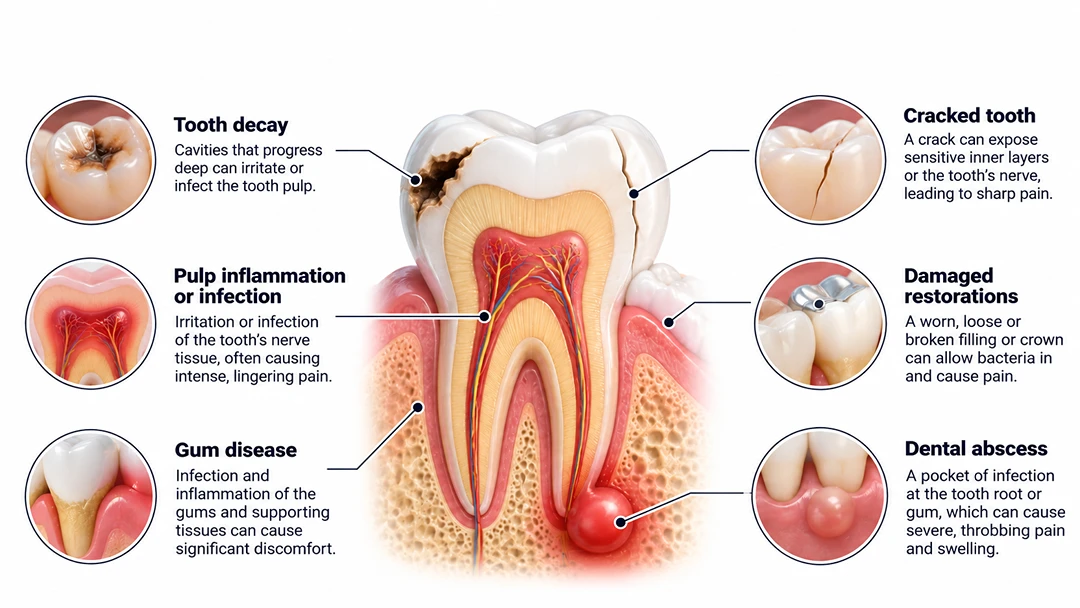
Tooth pain can originate from within the tooth or from the surrounding gums and supporting tissues. Some of the more common causes include:
Deep tooth decay
Tooth decay begins when acids produced by bacteria gradually break down the tooth’s enamel. As decay progresses into the dentine, the tooth can become increasingly sensitive. If it reaches the dental pulp, where the nerves and blood vessels are located, it can cause significant pain and inflammation.
Pulp inflammation or infection
The dental pulp can become inflamed due to deep decay, cracks or trauma. This inflammation, known as pulpitis, can cause lingering sensitivity to hot or cold temperatures, spontaneous toothache or throbbing pain. If the pulp becomes irreversibly inflamed or infected, root canal treatment or extraction may be necessary.
Dental abscess
A dental abscess is a collection of pus caused by a bacterial infection. It can develop near the tip of a tooth’s root or within the surrounding gum tissues. Symptoms include persistent throbbing pain, tenderness when biting, and swelling. Some people also notice a small, pimple-like bump on the gum that drains pus.
Cracked or fractured tooth
A crack can extend through the enamel and into the deeper layers of a tooth, sometimes reaching the pulp. Pain often occurs when biting or releasing pressure, although some cracks cause more persistent discomfort. Not all cracks are visible to the naked eye.
Damaged or loose dental restorations
A broken filling or loose crown can expose sensitive tooth structure or allow bacteria to enter beneath the restoration. This can lead to discomfort when eating or drinking, especially if decay has developed underneath.
Dental trauma
An injury to the mouth can damage a tooth even when there are no obvious chips or fractures. The impact can affect the dental pulp, root or tissues holding the tooth in place, resulting in pain, tenderness or increased sensitivity.
Gum and periodontal problems
Gum infections and periodontal disease can cause pain around the teeth, particularly when inflammation affects deeper supporting tissues. A periodontal abscess, for example, can cause localised swelling and pain when chewing.
Teeth grinding or clenching
Repeated grinding or clenching places excessive pressure on the teeth and their supporting tissues. Over time, this can lead to aching, sensitivity or discomfort when biting. It can also contribute to tooth wear and fractures.
What are the signs and symptoms of severe toothache?
The symptoms accompanying a toothache can vary depending on its underlying cause. While some people experience pain only when eating or drinking, others have discomfort that persists without an obvious trigger.
Common signs and symptoms include:
- Sharp, throbbing or persistent pain in or around a tooth
- Pain that develops without an obvious trigger
- Sensitivity to hot or cold foods and drinks
- Pain or tenderness when biting or chewing
- Swollen, red or tender gums around the affected tooth
- A pimple-like bump on the gum, sometimes accompanied by pus or an unpleasant taste
- Swelling of the cheek or jaw
- Pain that becomes more noticeable at night or interferes with sleep
Understanding different types of tooth pain
The way a toothache feels can provide clues about what is happening inside the tooth or its surrounding tissues. Dentists consider the nature of the pain, what triggers it and how long it lasts when investigating the possible cause.
|
Type of tooth pain |
What it could mean |
|
Sharp, sudden pain |
A cracked tooth, exposed dentine or irritation of the dental pulp |
|
Throbbing or spontaneous pain |
Significant pulp inflammation or an infection affecting the tooth |
|
Brief sensitivity to hot or cold |
Exposed dentine or reversible pulpitis, where the pulp is inflamed but can potentially recover |
|
Lingering pain after hot or cold exposure |
Irreversible pulpitis, where the inflammation has progressed beyond the pulp’s ability to recover |
|
Pain when biting or releasing pressure |
A cracked tooth or inflammation of the tissues (periodontium) surrounding the root caused by root canal infection, gum infection, or dental trauma. |
|
Dull, persistent aching |
Teeth grinding, clenching or inflammation involving the tooth and its supporting structures (periodontium). |
These patterns are not exclusive to any one condition. For example, a cracked tooth can cause both biting pain and temperature sensitivity.
How is severe tooth pain diagnosed?
Finding the source of a toothache is not always straightforward. Pain can sometimes spread to neighbouring teeth or other parts of the jaw, making it difficult to identify which tooth is responsible.
Your dentist will first ask about your symptoms, including when the pain started, what triggers it and whether it lingers after eating or drinking. They will then examine your teeth and surrounding tissues to look for possible causes.
Depending on the findings, the assessment may involve:
- Clinical examination — Checking for tooth decay, cracks, damaged restorations, gum swelling and other visible abnormalities.
- Bite and percussion tests — Applying pressure or gently tapping individual teeth to identify tenderness that could indicate a crack or inflammation around the root.
- Pulp sensitivity tests — Using cold, heat or electrical stimuli to assess how the nerves within the dental pulp respond.
- Periodontal examination — Measuring gum pocket depths and checking the supporting tissues for signs of periodontal disease or infection.
- Dental X-rays and CBCT scans — Conventional dental X-rays help identify decay, infection-related changes around the roots and abnormalities in the surrounding bone. In complex cases, a cone beam computed tomography (CBCT) scan may be recommended to provide detailed 3D images when conventional imaging is insufficient.
Not every patient requires all these tests. Your dentist will select the appropriate assessments based on your symptoms and initial examination findings.
How is severe toothache treated?
Treatment for severe toothache depends on the underlying cause and the condition of the affected tooth. While painkillers can provide temporary relief, dental treatment is often needed to resolve the problem.
|
Treatment |
When is it recommended? |
|
Dental filling |
For tooth decay that can be removed and restored without requiring treatment of an irreversibly damaged dental pulp, such as a normal pulp or pulp with reversible inflammation. |
|
Repair or replacement of restorations |
When a damaged filling or loose crown exposes sensitive tooth structure or contributes to decay beneath the restoration. |
|
When the dental pulp is irreversibly inflamed or infected. The affected pulp is removed, and the root canals are cleaned, disinfected and sealed to preserve the tooth. |
|
|
Dental abscess drainage |
When an infection causes a collection of pus. Drainage helps relieve pressure, although root canal treatment or extraction is often needed to address the source. |
|
Periodontal treatment |
When pain originates from gum disease or infection of the supporting tissues. Treatment can include deep cleaning or drainage of a periodontal abscess. |
|
Cracked tooth treatment |
Depending on the depth and extent of the crack, treatment can involve banding with a molar band, a crown or root canal treatment. Teeth with extensive fractures may require extraction. |
|
Tooth extraction |
When extensive decay, fractures or loss of supporting bone make the tooth unsuitable for predictable restoration or preservation. |
What happens if severe tooth pain is left untreated?
Ignoring a persistent toothache can allow the underlying dental problem to worsen, even if the pain becomes less noticeable over time. What happens next depends on the cause and how far the condition has progressed.
For example, untreated tooth decay can eventually reach the dental pulp, causing irreversible inflammation or infection. If the pulp becomes infected, bacteria can spread through the root canals into the tissues surrounding the root, potentially leading to a dental abscess.
Delaying treatment can also make it harder to preserve the affected tooth and control the infection. As decay or structural damage progresses, less healthy tooth structure remains available for restoration. A tooth that could initially have been treated with a filling or root canal treatment may eventually require extraction.
In more serious cases, a dental infection can spread beyond the affected tooth, causing facial swelling and potentially involving deeper tissues of the face or neck.
When should I see a dentist for tooth pain?
An occasional, brief episode of tooth sensitivity does not always indicate a serious problem. However, if your toothache persists, becomes more painful or starts interfering with daily activities, it is important to have it assessed.
Arrange a dental appointment promptly if you experience:
- Severe tooth pain that disrupts your sleep or makes eating difficult
- Persistent or worsening pain, even after taking painkillers
- Pain when biting or chewing
- Swelling or tenderness around the affected tooth
- A pimple-like bump on the gum or discharge of pus
- Tooth pain following an injury, fall or impact to the mouth
- Recurring pain in a tooth that has previously undergone dental treatment
When is a toothache a medical emergency?
A dental infection can occasionally spread beyond the affected tooth and involve deeper tissues of the face or neck.
Seek immediate medical attention if you experience:
- Rapidly increasing swelling of the face, jaw or neck
- Difficulty breathing or swallowing
- Swelling around the eye, particularly if accompanied by visual changes
- Fever accompanied by facial swelling, significant illness or rapidly worsening symptoms
- Difficulty opening your mouth, especially alongside swelling or fever
These symptoms can indicate a spreading infection that requires urgent medical assessment. Do not wait for a routine dental appointment if you experience them.
Severe toothache assessment and treatment in Singapore
Severe tooth pain can be distressing, especially when it affects your ability to eat or sleep. At Aster Dental, our dentists assess the source of your discomfort and recommend treatment based on the condition of your tooth, with an emphasis on preserving natural teeth where clinically appropriate.
If you’re experiencing persistent or worsening tooth pain, contact us to arrange an urgent consultation.
Frequently Asked Questions (FAQs)
Can severe toothache go away on its own?
Tooth pain can sometimes subside without treatment, but this does not necessarily mean the underlying problem has resolved. For example, pain caused by an infected or severely inflamed dental pulp can decrease when the nerve tissue dies, even though the infection may continue to progress.
If your toothache has been severe or keeps returning, it is important to have the cause assessed, even if the pain temporarily disappears.
Will antibiotics stop severe toothache?
Antibiotics are not routinely prescribed for toothache because they cannot repair decay, treat an inflamed dental pulp or fix a cracked tooth. Even when a dental infection is present, treatment such as root canal therapy, drainage or extraction is usually needed to address its source.
Antibiotics are generally reserved for certain infections, such as those accompanied by fever, systemic illness or spreading swelling. Your dentist will determine whether they are necessary.
What can I do to relieve severe toothache while waiting to see a dentist?
While waiting for your dental appointment, you can take a few steps to manage the discomfort:
- Take suitable over-the-counter pain relief, such as paracetamol or ibuprofen, according to the product instructions and your medical suitability.
- Avoid chewing on the painful side of your mouth.
- Choose softer foods and avoid very hot, cold or sweet foods if they trigger sensitivity.
- Continue brushing gently to keep the affected area clean.
- Avoid placing aspirin or other painkillers directly against the tooth or gums, as this can damage the tissues.
These measures provide temporary relief but will not resolve the underlying dental problem.
Why does my toothache feel worse at night?
Tooth pain can become more noticeable at night because there are fewer distractions. Lying down can also contribute to a sensation of pressure or throbbing in an already inflamed tooth due to increased blood flow to the head
If the pain repeatedly wakes you from sleep or makes it difficult to rest, it can indicate a dental problem requiring prompt assessment.
Why does my tooth hurt when I bite but not at other times?
Pain that occurs only when biting can be associated with a cracked tooth, an uneven restoration or inflammation of the tissues surrounding the root from extension of root canal infection, gum infection and dental trauma
For example, a cracked tooth can cause sharp pain when pressure is applied or released, while inflammation around the root often causes tenderness when biting down.
Can tooth pain spread to my ear or jaw?
Yes. Tooth pain can sometimes be felt near the ear, temple, jaw or neighbouring teeth because these areas share nerve pathways. This is known as referred pain.
It can make identifying the affected tooth difficult, particularly when the pain originates from an inflamed dental pulp.
Can a tooth hurt even if there is no visible cavity?
Yes. Not all dental problems are visible from the outside. A tooth can develop pain from a hidden crack, decay beneath an existing filling or crown, aberrant tooth anatomy with a propensity for bacteria to invade the pulp and cause inflammation, or previous trauma.
Some conditions affect the internal structures of the tooth long before any obvious changes appear on its surface.
Does severe toothache always mean I need root canal treatment?
Mostly yes. However, not all severe toothaches automatically mean that root canal treatment is necessary. If the pain is caused by a cavity that has not irreversibly damaged the pulp, a filling may be sufficient.
Root canal treatment is generally considered when the pulp is irreversibly inflamed or infected and the tooth can still be preserved. Other conditions may require periodontal treatment, restoration repair or extraction.
Can a tooth that has undergone root canal treatment start hurting again?
Yes. Although the pulp tissue has been removed during root canal treatment, the tissues surrounding the tooth root can still become inflamed or infected.
Pain can develop because of persistent or recurrent infection, new decay, a fracture or problems involving the surrounding gums. Depending on the cause, treatment options may include root canal retreatment, endodontic surgery or extraction.
Can severe toothache be prevented?
Not every toothache can be prevented, particularly when it results from an unexpected injury or fracture, or unusual aberrant tooth anatomy that hides an inapparent nidus of bacteria. However, good oral hygiene and early treatment of dental problems can reduce the risk. Brush twice daily with fluoride toothpaste, clean between your teeth regularly, and attend routine dental examinations. Avoid chewing hard objects, and consider a protective mouthguard if you grind your teeth or participate in contact sports.
Addressing tooth sensitivity, damaged fillings or early decay before they worsen can also help prevent more extensive dental problems.