
Endodontic Surgery (Apicoectomy)
An apicoectomy is a type of endodontic surgery used to treat persistent infection around the tip of a tooth root. Find out how the procedure is performed and when it may be recommended.
Quick Links
At a Glance:
|
What it is |
A surgical endodontic procedure that removes the tip of a tooth’s root and surrounding infected or inflamed tissue to help preserve the natural tooth. |
|
When it is needed |
When infection or inflammation persists or returns after root canal treatment and conventional retreatment is unsuitable or unlikely to resolve the problem. |
|
How it is performed |
A small incision is made in the gum to access the root tip. Approximately 3 mm of the root tip is removed, and the remaining root canal is sealed with a biocompatible filling material. |
|
Anaesthesia |
Local anaesthesia. Patients remain awake throughout the procedure, with the affected area numbed to minimise pain. |
|
Recovery |
Mild swelling, tenderness or bruising is common during the first few days. Most patients can resume normal daily activities within 1–2 days. |
|
Healing time |
Gum tissue typically heals within 1–2 weeks, while the surrounding bone takes several months to heal. |
|
Treatment goal |
To address persistent infection and preserve the natural tooth when further conventional root canal treatment is not suitable. |

What is an apicoectomy?
An apicoectomy, also known as root-end surgery, is an endodontic procedure used to treat persistent infection or inflammation around the tip of a tooth’s root. It is usually considered when a tooth has previously undergone root canal treatment, but the surrounding tissues have not healed or infection has returned.
Unlike conventional root canal treatment, which accesses the canals through the crown of the tooth, an apicoectomy approaches the root tip through the gum. During the procedure, the affected tissue and a small portion of the root tip are removed before the end of the root canal is sealed to prevent further bacterial leakage.
The aim of an apicoectomy is to address persistent infection while preserving the natural tooth, particularly when further conventional root canal treatment is unsuitable or unlikely to resolve the problem.
When is an apicoectomy needed?
An apicoectomy is needed when infection or inflammation persists around the root tip after root canal treatment and cannot be adequately addressed through conventional root canal retreatment.
Common reasons for performing an apicoectomy include:
- Persistent infection after root canal treatment — Infection or inflammation remains around the root tip despite previous treatment.
- Recurrent infection — Infection returns in an adequately previously treated tooth, even after an initial period of healing.
- Complex root canal anatomy — Narrow, curved or inaccessible canals prevent certain areas from being adequately cleaned and treated through conventional methods.
- Obstructions within the root canal — Dental posts, separated instruments or other obstructions prevent access to the affected area during conventional retreatment.
- Need for direct examination of the root — Surgery allows the endodontist to examine the root surface for fractures or other abnormalities that cannot be identified through conventional assessment.
An apicoectomy is not necessary for every failed root canal treatment. The decision depends on whether the tooth can be preserved and whether non-surgical retreatment can adequately address the underlying problem.
Apicoectomy vs root canal retreatment: what's the difference?
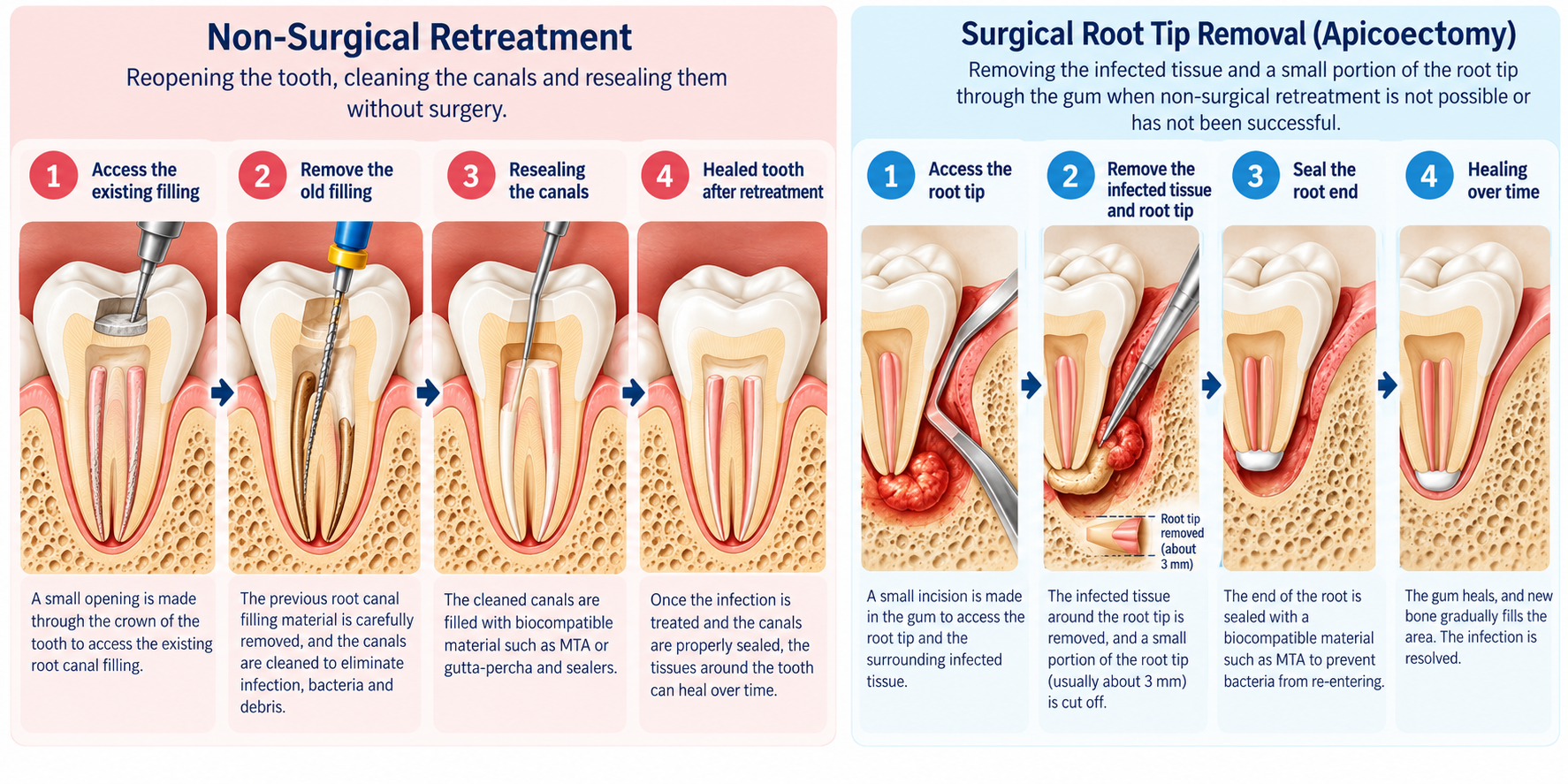
Both apicoectomy and root canal retreatment aim to preserve a natural tooth when infection persists or returns after previous root canal treatment. However, they differ in how the affected area is accessed and treated.
|
Root Canal Retreatment |
Apicoectomy (Endodontic Surgery) |
|
|
How it works |
The existing root canal filling is removed, and the canals are cleaned, disinfected and refilled. |
The root tip and surrounding infected or inflamed tissue are surgically removed, and the root end is sealed. |
|
Access |
Through the crown of the tooth. |
Through an incision in the gum just enough to expose the tooth, followed by an opening in the surrounding bone to reach the root tip. |
|
When is it recommended |
When the root canals can be accessed and the cause of persistent infection can be addressed internally. |
When conventional retreatment is unsuitable, has been unsuccessful, or is unlikely to resolve the infection. |
|
Existing restorations |
A crown or filling may need to be removed or accessed to reach the canals. |
Existing restorations can often remain in place. |
|
Recovery |
Usually involves temporary tooth tenderness or sensitivity after treatment. |
Involves healing of the surgical site, with possible swelling, tenderness, or bruising, manageable with medications. |
Which treatment is more suitable?
The choice depends on the cause of the persistent infection, the condition of the existing root canal filling, and the tooth’s overall structure. Your endodontist will assess whether the problem can be resolved through non-surgical retreatment or whether surgical access to the root tip is necessary.
Both procedures aim to eliminate infection and preserve the natural tooth, although neither guarantees long-term success.
What does an Apicoectomy involve?
An apicoectomy is a minor surgical procedure performed under local anaesthesia. Understanding what happens before and during surgery can help you prepare for treatment.
Before the Procedure
Your endodontist will examine the affected tooth and review your dental history, previous root canal treatment and X-rays. Additional imaging, such as a CBCT scan, can be used to assess the root anatomy, locate the infection and plan the surgical approach.
Before surgery, your endodontist will explain the procedure, discuss potential risks and provide instructions on how to prepare. You should also inform your endodontist about any medications you take and existing medical conditions.
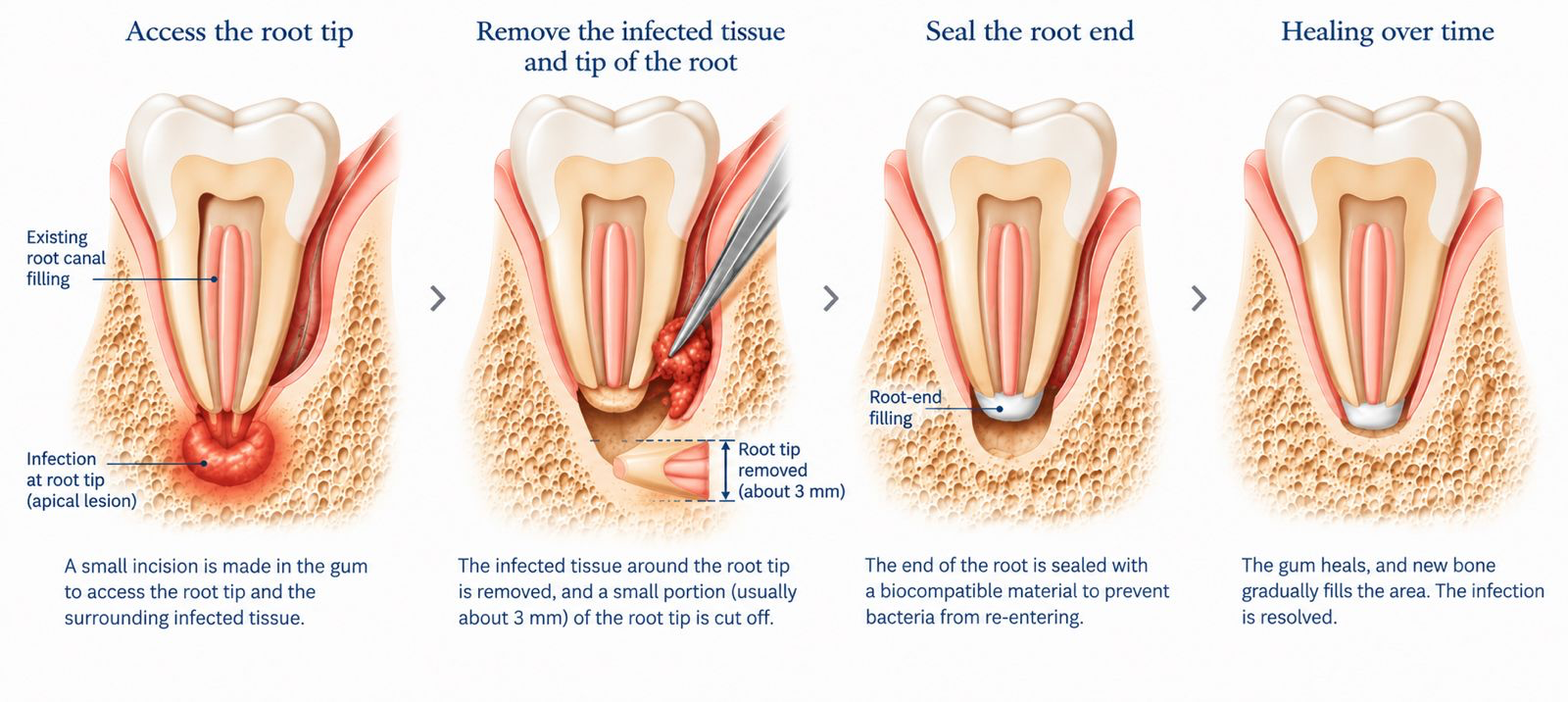
During the Procedure
The procedure is performed under local anaesthesia to numb the affected area. You may feel some pressure or movement during surgery, but not sharp pain.
The procedure generally involves these steps:
- Accessing the root tip: An incision is made in the gum, and an opening is created in the underlying bone to expose the affected root tip.
- Removing infected tissue: The infected or inflamed tissue surrounding the root tip is carefully removed.
- Resecting the root tip: Approximately 3 mm of the root tip is removed to eliminate the affected portion.
- Preparing the root end: The exposed root canal is cleaned and prepared using specialised instruments.
- Sealing the root end: A biocompatible filling material is placed to seal the root canal and prevent further bacterial leakage.
- Closing the surgical site: The gum tissue is repositioned and secured with sutures.
Following the procedure, the gum tissue begins healing while the surrounding bone gradually regenerates over the following months. Your endodontist will arrange follow-up appointments to monitor healing and assess the treatment outcome.
After the Procedure
Following an apicoectomy, you can expect some swelling, tenderness and mild bruising around the surgical site. These symptoms are usually most noticeable during the first 24 to 48 hours before gradually improving.
Most patients can resume their usual daily activities within a day or two, although strenuous exercise should be avoided during the initial recovery period. The gum tissue typically heals within one to two weeks, while the surrounding bone takes several months to heal.
Your endodontist will provide post-operative care instructions and arrange follow-up appointments to monitor healing. Follow-up X-rays may also be taken to assess bone healing and determine whether the infection has resolved.
Can an Apicoectomy save your natural tooth?
Yes, an apicoectomy can help preserve a natural tooth when infection persists after root canal treatment. By removing the affected root tip and sealing the remaining canal, the procedure aims to eliminate the source of infection without extracting the tooth.
However, treatment success depends on several factors, including the extent of infection, the condition of the surrounding bone, the tooth’s structural integrity and its periodontal health.
Not every tooth can be saved with an apicoectomy. Teeth with vertical root fractures, extensive structural damage or insufficient supporting bone may require extraction instead. Your endodontist will assess the tooth’s long-term prognosis before recommending surgery, with the goal of preserving your natural tooth whenever clinically appropriate.
Endodontic surgery in Singapore
At Aster Dental, our endodontic services focus on treating infections within and around the tooth while preserving natural teeth whenever possible.
For patients experiencing persistent infection after root canal treatment, our endodontist will assess the affected tooth, review previous treatment and determine whether non-surgical retreatment or an apicoectomy is more suitable.
If you have been advised to undergo endodontic surgery or are experiencing recurring problems with a previously treated tooth, contact us for a detailed examination and personalised treatment plan.
Frequently asked questions
Is an apicoectomy painful?
An apicoectomy is typically performed under local anaesthesia, so you will remain awake while the affected area is numbed. You may feel some pressure during surgery, but you should not experience sharp pain. Additional anaesthesia will be given when treatment time is longer in more complex roots. Mild discomfort, swelling and tenderness are common afterwards and generally improve within a few days.
How long does an apicoectomy take?
An apicoectomy typically takes around 60 to 90 minutes, depending on the tooth’s location, root anatomy, and complexity of the procedure. Your endodontist can provide a more accurate estimate following an examination.
Is an apicoectomy better than root canal retreatment?
Neither procedure is inherently better. Root canal retreatment is generally preferred when the canals can be accessed, and the underlying problem can be addressed without surgery. An apicoectomy is considered when non-surgical retreatment is unsuitable, has been unsuccessful or is unlikely to resolve the infection.
Can an infection return after an apicoectomy?
Yes. Although an apicoectomy aims to remove infected tissue and seal the root end, infection can persist or recur in 10% of cases if resistant bacteria remain within the root canal system or the tooth develops other complications. Follow-up examinations and X-rays help monitor healing and identify any recurring problems.
Can an apicoectomy be performed on any tooth?
Apicoectomies can be performed on different types of teeth, including front teeth, premolars and molars. However, suitability depends on the tooth’s root anatomy, accessibility, surrounding structures and overall condition. Some teeth are more difficult to treat surgically because of their location or proximity to nerves and sinuses.
Will I need to take time off work after an apicoectomy?
Most patients can return to non-strenuous activities within one or two days. However, swelling and tenderness can make it more comfortable to rest initially. Patients whose work involves strenuous physical activity may need additional recovery time.
What happens if an apicoectomy is unsuccessful?
If infection persists or the surrounding tissues do not heal as expected, your endodontist will reassess the tooth to determine the cause. Depending on the findings, further treatment, repeat surgery or tooth extraction may be considered.