
Quick Links
At a Glance:
What it is | Persistent or recurrent infection or inflammation in a previously root canal-treated tooth |
Common symptoms | Tooth pain, pain when biting, gum swelling, tenderness or a pimple-like bump on the gum |
When it can occur | Shortly after treatment or months to years later |
Possible causes | Missed or complex canals, incomplete disinfection, leakage, new decay, cracks or fractures |
How it is assessed | Dental examination and specialised imaging |
Treatment options | Root canal retreatment, endodontic surgery or tooth extraction, depending on the condition of the tooth |
Can the tooth be saved? | In many cases, yes. This depends on the cause of failure, remaining tooth structure and whether the tooth can be predictably restored |
Root canal treatment is performed to remove infected or inflamed tissue from inside a tooth, clean and seal the root canals, and preserve the natural tooth. Although treatment is designed to provide a long-term solution, infection or inflammation can sometimes persist or return.
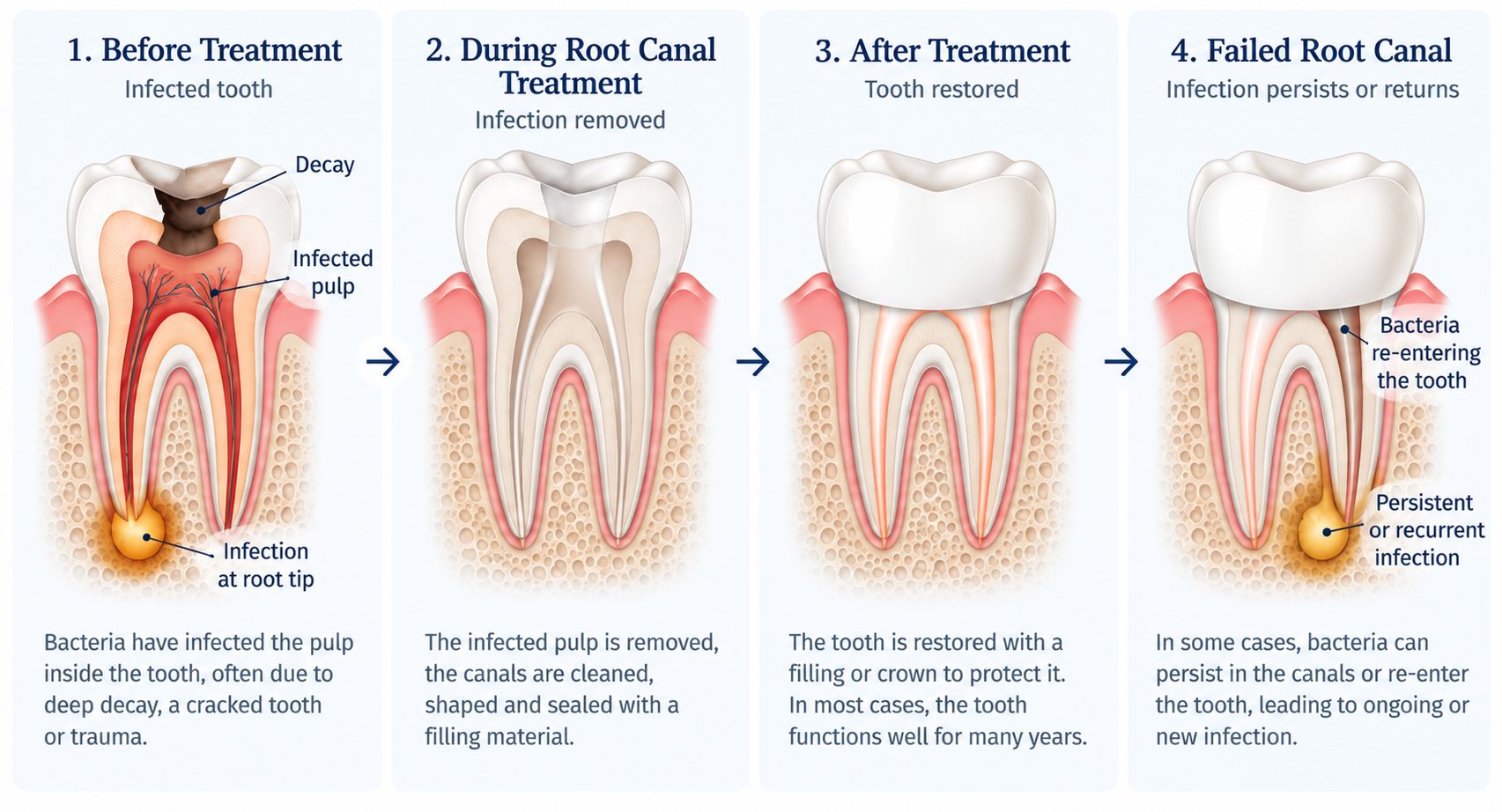
A failed root canal refers to a previously treated tooth where infection or inflammation persists, does not heal as expected, or recurs after treatment. This can occur soon after a root canal or months to years later.
That said, a failed root canal does not necessarily mean the tooth needs to be extracted. Identifying why the root canal has failed is important, as some teeth can still be preserved through further endodontic treatment.
What are the symptoms of a failed root canal?
A tooth that has undergone root canal treatment should generally become more comfortable as the surrounding tissues heal, with symptoms usually resolving within 1 to 6 months, depending on the severity of infection you presented with initially. If symptoms persist, return after initially improving, or develop months or years later, further assessment may be needed.
Signs that can be associated with a failed root canal include:
- Persistent or recurring tooth pain
- Pain or tenderness when biting or chewing
- Swelling of the gum around the treated tooth
- A pimple-like bump on the gum, which can indicate drainage from an infection
- Tenderness around the tooth or surrounding gums
- Swelling of the face or jaw in more significant infections
Importantly, not every failed root canal causes obvious symptoms. Persistent infection can sometimes be detected on a dental X-ray during a routine examination, even when the tooth feels normal.
Why do root canals fail?
A root canal can fail when bacteria remain within the root canal system or find a way to enter the tooth again after treatment. This can happen for several reasons:
Possible Cause | How It Can Affect the Tooth |
Missed or complex root canals | Some teeth have narrow, curved or additional canals that can be difficult to identify and thoroughly clean during the initial treatment. |
Persistent bacteria | Bacteria can remain within areas of the root canal system that are difficult to reach or disinfect. |
Leakage around a filling or crown | A damaged, old, loose, or poorly sealed restoration can allow bacteria to re-enter the treated tooth. |
New tooth decay | Decay developing around the restoration can create another pathway for bacteria to reach the root canal system. |
Cracks or fractures | A new or previously undetected crack can allow bacteria into the tooth and can affect whether the tooth can be preserved. |
Delayed restoration | If the tooth is not permanently restored and sealed after root canal treatment, it can become contaminated again. |
In some cases, the reason for persistent infection is not obvious until the tooth is examined more closely.
How is a failed root canal diagnosed?
Diagnosing a failed root canal involves identifying whether infection or inflammation is still present, what may be causing it, and whether the tooth can be preserved.
Assessment can include:
- Clinical examination — The dentist checks the treated tooth and surrounding gums for tenderness, swelling, drainage, cracks or other signs of infection.
- Bite and percussion tests — Gentle pressure or tapping can help identify tenderness in the tissues surrounding the root.
- Dental X-rays — X-rays can reveal changes around the root tip, the quality and extent of the previous root canal filling, and other possible sources of infection.
- Cone Beam Computed Tomography (CBCT) imaging — In more complex cases, a CBCT scan provides a three-dimensional view of the tooth and surrounding structures. It can help identify missed canals, unusual root anatomy, fractures or areas of persistent infection that may not be clearly visible on conventional X-rays.
- Assessment of the existing restoration — The filling or crown is examined for leakage, decay, damage or other factors that could allow bacteria to re-enter the tooth.
The findings help determine why the previous treatment has not healed as expected and whether root canal retreatment, endodontic surgery or another treatment approach is appropriate.
How is a failed root canal treated?
Treatment depends on why the root canal has failed, the extent of infection, and whether the tooth has enough healthy structure to be preserved. Where possible, the goal is to address the source of the problem while retaining the natural tooth.
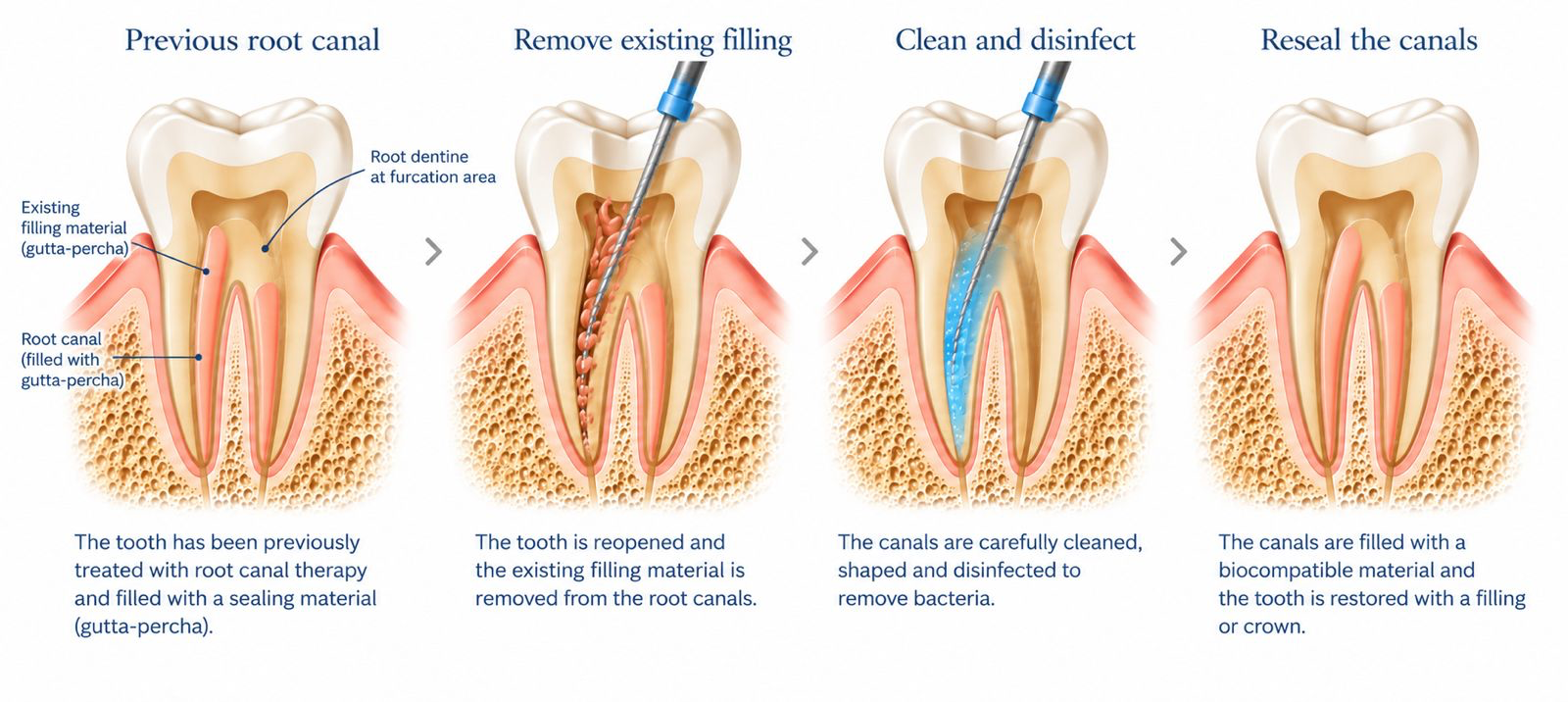
Root canal retreatment
The previous root canal filling is removed so the canals can be re-examined, cleaned, disinfected and sealed again. This can be considered when persistent infection, missed canals or problems with the previous treatment can be addressed through the tooth.
Endodontic surgery (apicoectomy)
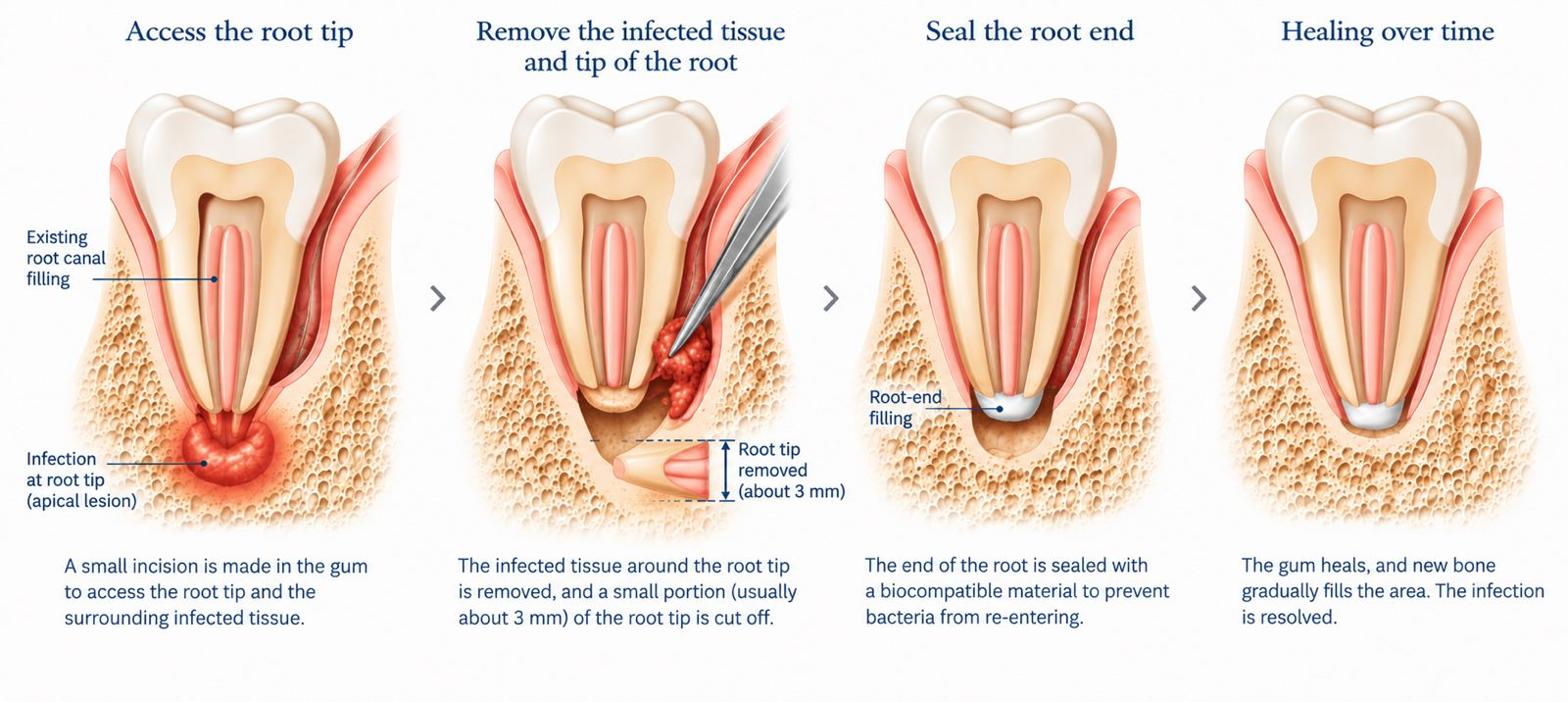
Endodontic surgery can be considered when infection or inflammation persists around the tip of the tooth root and conventional root canal retreatment is not suitable or has not resolved the problem.
During an apicoectomy, the gum is accessed to reach the affected area, infected tissue is removed, and a small portion of the root tip is removed and sealed to help prevent bacteria from re-entering the root canal system. This approach can provide another option for preserving the natural tooth when treatment through the root canal alone is insufficient.
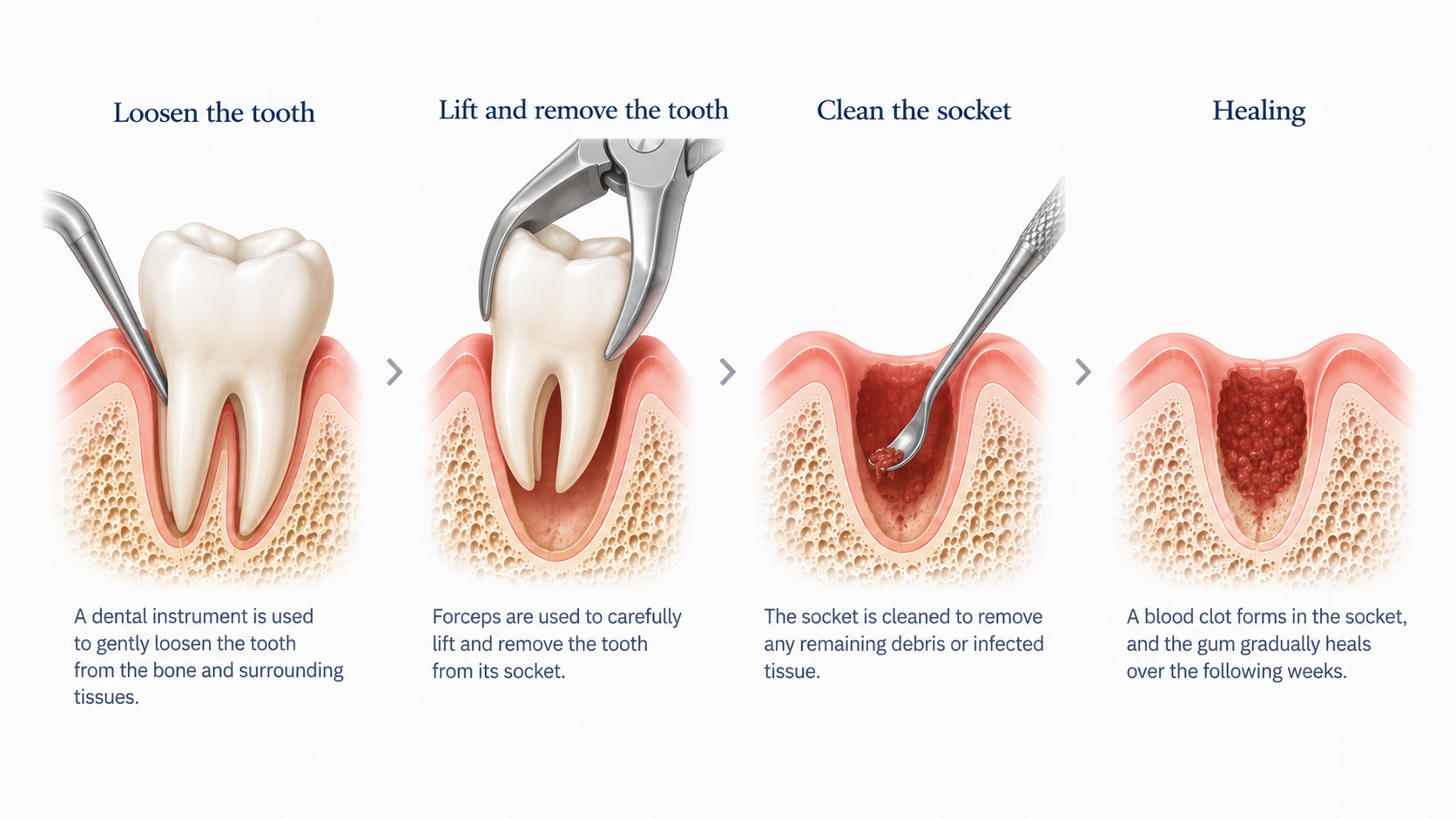
Tooth extraction
Removal of the tooth can be necessary when it cannot be predictably restored or preserved, such as with certain root fractures or extensive loss of tooth structure. Replacement options can then be discussed.
Why are failed root canals more complex to treat?
Treating a tooth that has already undergone root canal treatment can be more complex than performing the initial procedure. The dentist is not only treating infection but also working with a tooth and root canal system that have already been accessed, filled and often restored with a filling, crown or post.
Retreatment can involve additional challenges such as:
- Removing existing root canal filling materials to regain access to the canals
- Working around crowns, posts or other restorations that can limit access to the root canal system
- Locating previously missed or difficult-to-access canals, which may be narrow, curved, calcified or unusually shaped
- Managing procedural complications from previous treatment, such as separated instruments or altered canal anatomy
- Locating persistent bacteria within areas of the root canal system that were difficult to clean during the first treatment. Often, these bacteria are more recalcitrant and harder to eliminate.
- Assessing cracks or fractures that can affect whether further treatment is likely to succeed
What happens if a failed root canal is left untreated?
If persistent or recurrent infection is present, it is unlikely to resolve on its own. Symptoms can sometimes improve temporarily, but this does not necessarily mean the underlying infection has cleared.
Without proper treatment, the infection can continue to affect the tissues surrounding the tooth and may lead to:
- Persistent or recurring pain and tenderness
- Swelling or the formation of a dental abscess
- A recurring pimple or draining sinus on the gum
- Loss of bone around the affected root
- Increasing difficulty preserving the tooth if the condition progresses
- Spread of infection into surrounding tissues in more significant cases
When should you see a dentist for a failed root canal?
Some tenderness can occur while a tooth heals following root canal treatment. However, symptoms that persist, worsen or return after the tooth initially felt better should be assessed.
You should arrange a dental evaluation if you experience:
- Persistent or recurring pain in a root canal-treated tooth
- Pain or tenderness when biting or chewing
- Swelling around the tooth or gums
- A pimple-like bump or discharge from the gum
- New swelling of the face or jaw
- A crown or filling on the treated tooth becoming loose, damaged or fractured
Depending on the cause and complexity of the problem, your dentist may recommend further assessment or treatment by an endodontist, a specialist in root canal treatment. This can be particularly helpful for complex retreatment cases involving missed or calcified canals, difficult root anatomy, previous treatment complications or persistent infection that has not resolved.
Seek prompt dental care if swelling is increasing, particularly if it affects the face or is accompanied by fever or difficulty swallowing.
Book a consultation
If a previously root canal-treated tooth has started causing pain, swelling or other symptoms again, a dental consultation can help determine what is happening within and around the tooth.
Aster Dental specialises in managing complex endodontic cases, including failed or previously treated root canals. Treatment is planned based on the condition of the tooth, the previous root canal treatment and the factors contributing to persistent or recurrent infection.
Book a consultation with us for a detailed diagnosis and a personalised treatment plan.
Frequently asked questions
Can a root canal fail years later?
Yes. A root canal-treated tooth can develop problems months or years after treatment, even if it initially healed and remained symptom-free. This can occur if bacteria persist within the root canal system or re-enter the tooth later because of new decay, leakage around a restoration, or a crack or fracture.
Does pain after a root canal mean it has failed?
Not necessarily. Some tenderness can occur while the tissues surrounding the tooth heal after root canal treatment. However, pain that persists, worsens or returns after the tooth has been comfortable for some time can indicate that further investigation is needed.
Can a failed root canal tooth still be saved?
In many cases, yes. Whether the tooth can be preserved depends on the reason for the failure, the amount of healthy tooth structure remaining, the condition of the surrounding tissues, and whether cracks or fractures are present. Treatment options can include root canal retreatment or endodontic surgery.
Can a failed root canal be treated again?
A failed root canal does not always require extraction. Whether the tooth can be preserved depends on the reason for the failure, the amount of healthy tooth structure remaining, the condition of the surrounding tissues, and whether cracks or fractures are present. Treatment options can include root canal retreatment or endodontic surgery.
Is it better to retreat a root canal or extract the tooth?
There is no single option that is suitable for every tooth. Retreatment can be considered when the underlying problem can be addressed and the tooth remains restorable. Extraction can be recommended when factors such as extensive structural damage or certain root fractures make preserving the tooth less predictable.
How many times can a root canal be retreated?
There is no fixed number of times a root canal can be retreated. The decision depends on what caused the previous treatment to fail, the procedures already performed, the remaining tooth structure and whether another attempt is likely to provide a predictable outcome.
Can a failed root canal cause an abscess?
Yes. Persistent or recurrent infection around a root canal-treated tooth can result in a dental abscess. This can cause pain, swelling, tenderness or a pimple-like bump on the gum that can intermittently drain.
Can a failed root canal have no symptoms?
Yes. Some persistent infections around root canal-treated teeth cause little or no noticeable discomfort and are instead identified on dental imaging. This is why the absence of pain does not necessarily confirm that a previously treated tooth is free from disease.